
Quick answer: Repair when the drywall is firm, flat, dry, and only stained (seal the stain, refinish, repaint). Replace when it is soft, sagging, bubbling at the seams, moldy, wet for more than a day or two, or hit by gray or black water. Always fix the leak and dry the area first. A sagging ceiling is a safety issue. Keep people out from under it.
Step one: stop the water, then let it dry
No drywall contractor can fix a wall that is still getting wet. Before we talk about patching, the source has to be repaired: the supply line, the roof, the window flashing, the water heater, the shower valve. Then the area needs to dry, not just on the surface but inside the wall or ceiling cavity.
Gypsum board soaks up water and wicks it upward and outward. A wall can feel dry to the touch while the core and the back of the board are still wet. A moisture meter, compared against a known-dry wall in the same house, is the most reliable way to know. Restoration companies use them every day, and so do we before we commit to a scope.
How to tell if water-damaged drywall can be repaired
In our experience, drywall is usually a repair candidate when all of these are true:
- The leak is fixed and the area has dried.
- The board is firm. Press gently with your fingers. It should feel like the rest of the wall.
- The surface is flat. No bulging, bowing, or waviness.
- The tape joints are intact. No bubbling or lifting tape along seams.
- There is no mold and no musty smell.
- The water was clean, like a supply line, not sewage or floodwater.
If those boxes are checked, the fix is often sealing the stain with a stain-blocking primer, touching up any finish damage, and repainting. Paint alone over an unsealed water stain usually lets the stain bleed back through.
When water-damaged drywall should be replaced
Drywall should come out when any of these show up:
- Soft, spongy, or crumbly board when pressed. The gypsum core has broken down.
- Sagging or bowing ceilings. Wet ceiling board gets heavy. Keep people and pets out from under it.
- Bubbling tape or swollen seams. Joints have failed and will keep failing.
- Visible mold or a persistent musty smell. Painting over mold does not fix it.
- Board that stayed wet for more than a day or two. The longer it stays wet, the more likely the paper facing and core are compromised.
- Contaminated water. The restoration industry standard (IICRC S500) classifies water by contamination. Gray water from appliances or black water from sewage or flooding generally means replacement, regardless of how the board looks.
- Wet insulation behind the board that needs to come out to dry the cavity.
If mold is present, bring in a qualified remediation professional first. Our job starts after the area is clean and dry.
What "replace" actually means on site
Replacing water-damaged drywall does not always mean a full room. Here is how our crews approach it:
- Find the edges of the damage. We check beyond the stain, because water travels. We cut back to solid, dry board.
- Open on a clean line. On walls, cuts land where the new piece can seam cleanly. On ceilings, we often replace to the framing so the new board is fully supported.
- Check the cavity. Framing, insulation, and backing get a look before new board goes up.
- Hang the right board. Matching thickness matters, or the patch will sit proud or sunken. In bathrooms and other wet areas, moisture-resistant board may be the better choice.
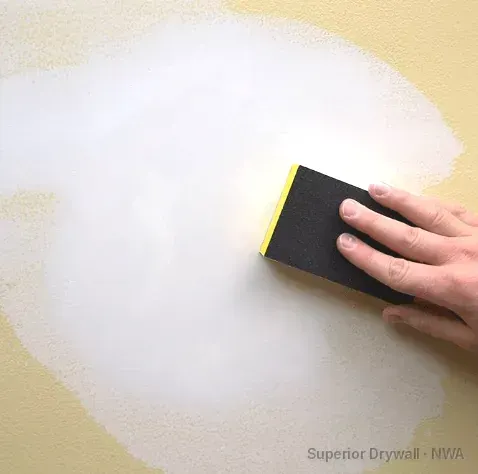
- Tape, coat, and sand with dust control. Coats need drying time between them.
- Match the finish. Smooth blend or texture matching for orange peel, knockdown, and hand textures.
- Prime and hand off ready for paint, with a walkthrough.
Ceilings are a different conversation
Ceilings under bathrooms, attics, and HVAC equipment are common trouble spots. Ceilings are harder because the water pools on top of the board, the stain may be small while the soaked area is large, and grazing light from windows will show any ridge in the repair. A stained but firm ceiling may only need sealing and refinishing. A ceiling that is sagging, soft, or has a "belly" between joists should be replaced, not patched.
What about insurance?
Insurance coverage depends on your policy and the cause of the leak, so we cannot tell you what your carrier will pay. What we can do is give you a written scope that shows exactly which areas are being removed, replaced, and finished. That scope is useful whether you are working with an adjuster, a restoration company, or paying directly. For larger losses, we can also walk the quote with you on Zoom so everyone sees the same line items. Learn more on our water damage drywall repair page.
What we see in Northwest Arkansas homes
We work across Bentonville, Rogers, Centerton, Pea Ridge, Little Flock, Springdale, Fayetteville, Bella Vista, Lowell, and Cave Springs. The pattern is the same everywhere: the water damage is usually bigger than the stain. The questions that set the scope are also the same: Is the source fixed? Is it dry? Is the board firm? Is there mold? What finish has to be matched? Older homes in established neighborhoods, like parts of Rogers, often have painted-over textures that make the blend the hardest part of the job.
How to get water-damaged drywall fixed
- Fix the leak and start drying.
- Take photos of the stain, the ceiling or wall, and anything that sags or bubbles.
- Call Alejandro at (479) 227-2660 for an estimate, or me (Herminio) at (479) 224-8693 for scheduling questions. Email works too: nwasuperiordrywall@gmail.com.
- We assess, write the scope, and schedule our in-house crew. Updates run through Jobber.
- The work is backed by our 1-year workmanship guarantee.
If the damage turns out to be small, it may just be a standard drywall repair.
Request a free estimate for water-damaged drywall · Call (479) 227-2660 · Mon–Sat, 8am–5pm
Frequently Asked Questions
Can I just paint over a water stain on drywall?
Not with regular paint. If the board is firm, dry, and mold-free, seal the stain with a stain-blocking primer first, then paint. Otherwise the stain usually bleeds through again.
How do I know if my drywall is still wet inside?
Surface feel is not reliable. A moisture meter compared with a known-dry wall in the same house gives a much better answer. Restoration pros and drywall crews use them before deciding on a scope.
Is a sagging ceiling dangerous?
It can be. Wet ceiling board gets heavy and can fail. Keep people and pets out from under it, stop the water, and have it assessed. Sagging ceiling board should be replaced, not patched.
Do you handle mold removal?
No. If mold is present, a qualified remediation professional should handle it first. We replace and finish the drywall once the area is clean and dry.
Will the new drywall match my existing texture?
We match orange peel, knockdown, and many hand textures closely, and we will tell you upfront if an aged or heavily painted texture cannot be cloned perfectly.
Do you work with insurance and restoration companies?
We provide a written scope of removal, replacement, and finishing that you can share with your adjuster or restoration company. Coverage decisions are up to your insurer.